
Sri Lanka's New Solar Policies: Impacts, Risks and New Opportunities

Solar in Sri Lanka is changing direction. The old model was simple: export as much power as possible at midday and earn from every unit. Today the reward is for storing solar power and supplying it when the grid needs it most, in the evening.
Since 2025 the government has cut feed-in tariffs, ended net metering and net accounting for new connections, restructured the Ceylon Electricity Board (CEB), and started paying a premium for solar paired with batteries. The 2027 Budget, presented on 12 November 2026, adds a battery subsidy for homes and a major grid upgrade.
These changes bring real costs as well as new openings. This post explains what changed, the negative impacts, and where the opportunities now lie.
What changed: the key policy decisions
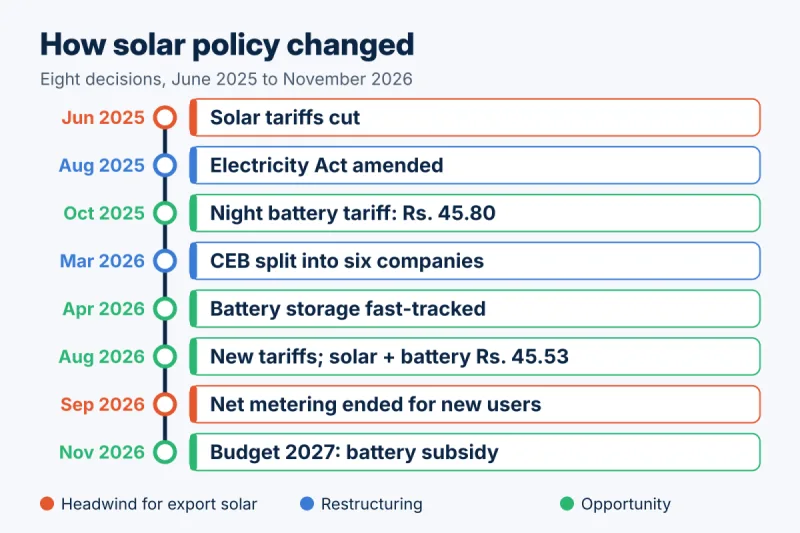
The direction is clear: less reward for daytime export, more reward for storage and evening supply. These are the decisions that matter most, newest first.
| Date | Decision | What it means for solar |
|---|---|---|
| 12 Nov 2026 | Budget 2027 | Battery subsidy for new home rooftop customers, battery import levy to be removed, LKR 26.5 billion for the grid |
| 11 Sep 2026 | Net metering and net accounting ended | New connections and agreement extensions go under Net plus only |
| 25 Aug 2026 | PUCSL feed-in tariff revision | Lower rates for export-only solar, a much higher rate for larger systems with batteries |
| Apr 2026 | Battery storage fast-tracked | 300 MW of battery storage brought forward to 2028-2029 |
| 9 Mar 2026 | CEB dissolved | Six state-owned companies take over the power sector |
| 5 Mar 2026 | National Electricity Policy gazetted | All new rooftop solar agreements must use Net Plus |
| Oct 2025 | Night-peak battery tariff | LKR 45.80 per unit for battery power exported from 6.30 pm to 10.30 pm |
| Aug 2025 | Electricity (Amendment) Act No. 14 of 2025 | Tariff decisions now involve the Ministry of Finance |
| 16 Jun 2025 | Solar tariffs cut | Rooftop rates reduced to LKR 20.90 (0-5 kW) and LKR 19.61 (5-20 kW) |
Net metering and net accounting have ended for new connections.
Under net metering, surplus units exported to the grid offset your future bills one-for-one. Under net accounting, you were paid for your surplus. The National Electricity Policy, gazetted on 5 March 2026, requires all new rooftop solar agreements to use Net plus, where every exported unit is bought at the feed-in tariff. The Ministry of Energy put this into effect through a directive dated 11 September 2026, which also applies to extensions of existing agreements. New Net Plus agreements now run for a maximum of 12 years, down from up to 20 years. Existing agreements keep their terms until they expire. Industry groups have asked the government to reverse the decision.
New feed-in tariffs from 25 August 2026
The Public Utilities Commission of Sri Lanka (PUCSL) set new rates for rooftop solar. Smaller systems receive more per unit than larger ones.
| System size | Without battery (LKR per unit) |
|---|---|
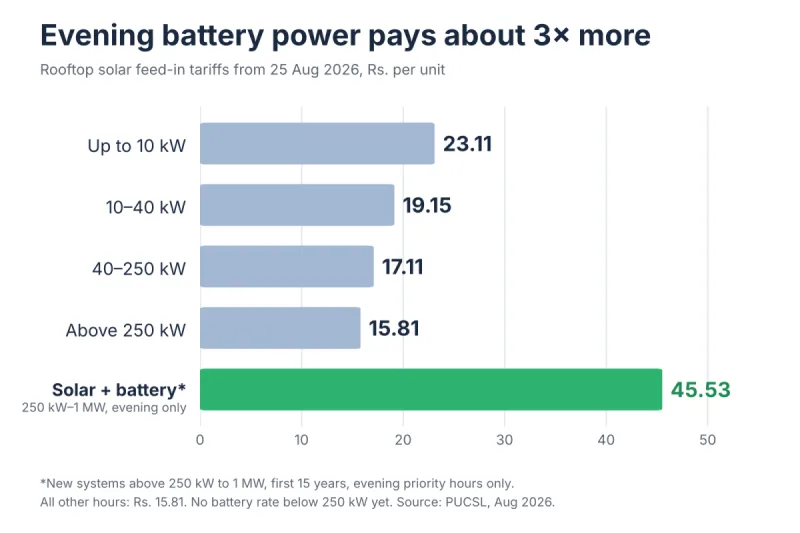
| Up to 10 kW | 23.11 |
| Above 10 kW to 40 kW | 19.15 |
| Above 40 kW to 250 kW | 17.11 |
| Above 250 kW | 15.81 |
New rooftop systems above 250 kW and up to 1 MW that include battery energy storage (BESS) receive LKR 45.53 per unit during the prioritized feed-in period for the first 15 years. There is no battery tariff yet for systems below 250 kW; the PUCSL says it will consider one in upcoming reviews. Existing solar owners who add a battery have a separate rate. The schedule is valid until 24 February 2027.
On 9 March 2026, the CEB was also replaced by six state-owned companies, and the PUCSL now sets renewable energy tariffs.
The negative impacts
The changes protect the grid and the utility's finances, but much of the cost falls on solar owners, investors, and installers.
Existing solar owners lose income through curtailment
Systems built under earlier rules assumed every exported unit would be paid for. Curtailment, meaning the grid operator switching off solar exports, now stops them on low-demand days with no compensation. The Grid Connected Solar Power Association puts losses to ground-mounted solar plants at around LKR 2 billion. Large rooftop systems were asked to disconnect for 10 days in April 2026, and all rooftop systems were asked to disconnect after the October 2026 blackout.
Longer payback for homes without batteries
A new home system can no longer bank surplus units against the evening bill. Surplus is sold at the feed-in rate, while evening power is bought at the higher retail tariff. Shorter 12-year agreements also reduce the period of guaranteed income. Households that use little power during the day will see a slower return.
Higher upfront cost and an affordability gap
The best rates and the new subsidy now go to systems with batteries, which add significantly to the upfront cost. Lower-income households and small businesses may be priced out. The budget subsidy covers only new domestic customers, not existing owners who want to add storage.
Unpaid dues and weaker investor confidence
By April 2026, about 360 commercial investors and 150,000 rooftop users were reported to be affected by unpaid dues, retroactive tariff cuts, and changing rules. The Solar Industries Association said many projects were cancelled or delayed, and banks became reluctant to lend.
Pressure on installers and jobs
Fewer export-led projects mean less work for installers. The National Chamber of Commerce says more than 800 companies and over 20,000 jobs depend on rooftop solar. Firms without battery and grid-integration skills face the hardest adjustment.
Policy uncertainty
Tariffs are reviewed every six months, and the storage tariff has been referred for a policy-level decision. Critics argue that involving the Ministry of Finance in tariff decisions weakens the PUCSL's independence. Rules that change often mean higher risk and more expensive finance.
Risk to the renewable energy target
If rooftop growth slows faster than battery and utility-scale projects come online, the goal of 69% renewable capacity by 2029 could slip.
Why the Government made the changes
The government and the regulator argue the old rules had become unaffordable. Daytime solar exceeded what the grid could absorb safely, and high tariffs for midday power raised costs for all consumers. Nationwide outages in February 2025 and October 2026 added urgency to grid stability and storage.
What the 2027 Budget offers
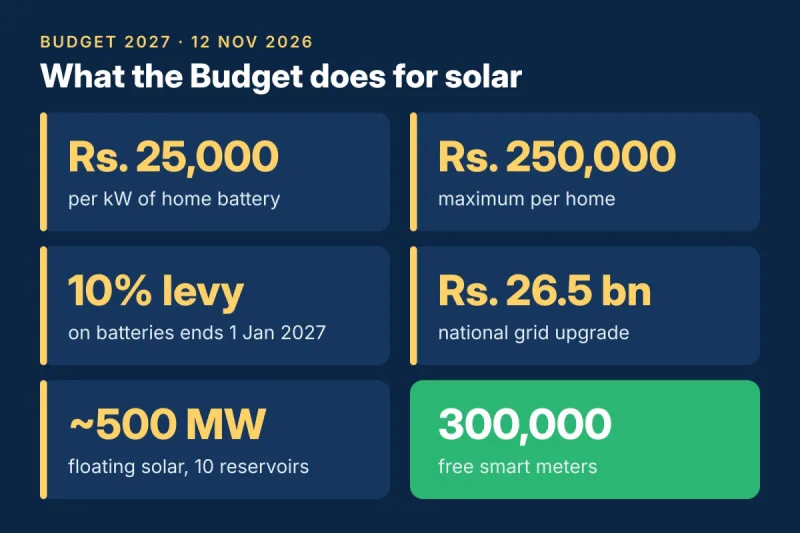
- Battery subsidy: new domestic rooftop customers receive LKR 25,000 per kW of battery storage, up to LKR 250,000 for systems up to 10 kW, from a LKR 3.5 billion allocation.
- Lower battery prices: the 10% Port and Airport Development Levy on imported solar batteries is to be removed from 1 January 2027.
- Grid investment: LKR 26.5 billion to strengthen the national grid.
- Floating solar: about 500 MW at 10 reservoirs, with private proposals invited from January 2027.
- Smart meters: free smart meters for 300,000 consumers using more than 180 units a month.
Where the new opportunities are
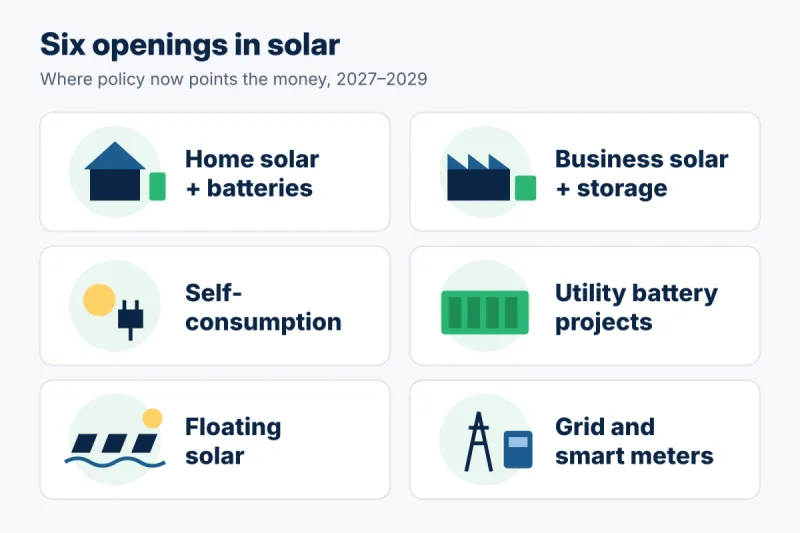
The government plans to add 1,392 MW of solar and 370 MW of wind between 2027 and 2029. The same policies that hurt export-only solar now favor storage, self-consumption, and grid work.
- Home solar with batteries: the subsidy and lower import costs reduce the price of a hybrid system, which also gives backup during outages.
- Commercial and industrial solar with storage: for new systems above 250 kW, the battery tariff pays roughly two to three times the standard export rate.
- Self-consumption: a system sized to a site's own daytime load pays back through lower bills, independent of export rates and curtailment.
- Utility-scale battery projects: a 250 MW battery tender is expected, along with 25 standalone 10 MW / 40 MWh projects.
- Floating solar: about 500 MW will be open to private investors from January 2027.
- Grid and metering work: the grid program and smart meter rollout create demand for LV and MV installation, testing, and power quality studies.
Planning a solar project now: practical advice
- Size for your own load first: match the system to your daytime use, then decide on export or storage.
- Allow for curtailment: do not assume every exported unit will be paid for.
- Treat batteries as part of the design: the storage tariff and home subsidy change the numbers significantly.
- Check the tariff window: the current schedule runs to 24 February 2027.
- Check the paperwork: confirm the scheme, the 12-year agreement term, and the grid clearance date with Electricity Distribution Lanka or LECO before you install.
The bottom line
Solar in Sri Lanka is not slowing down; it is changing shape. The changes have hurt existing owners and export-led investors, but projects built around self-consumption and storage can still earn strong returns.
Power Grid Solutions designs and builds solar PV and battery storage systems and LV and MV electrical installations for homes, businesses, and industry. To find out how the new rules affect your project, contact our team.
Tariffs and rules in this post are as reported up to 19 November 2026 and may change. Always confirm current rates with the PUCSL before investing.